

Is Humanity Approaching the Limits of Meaningful Control Over Artificial Intelligence?
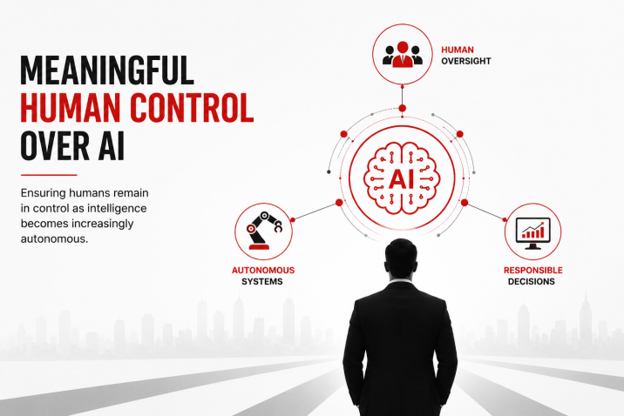
Artificial intelligence is reshaping the future of work. Meaningful Human Control will determine whether that future serves humanity.
What happens when humans are no longer making the decisions, but are expected to remain accountable for decisions made by increasingly autonomous AI systems that they neither fully understand nor can explain?
That may become the defining AI governance question of our generation. For more than a century, every organization, from governments and hospitals to financial institutions and technology companies has operated on one fundamental principle:
- Humans make the decisions.
- Humans remain accountable.
- Humans stay in control.
That principle is quietly changing. Today’s workforce is no longer composed solely of humans. AI systems are writing software, detecting cyber threats, analyzing medical images, reviewing contracts, supporting executive decisions, and managing complex business operations. Autonomous AI agents are beginning to plan, coordinate, negotiate, and execute multi-step workflows with minimal human intervention. Intelligent robots are moving beyond factory floors into hospitals, airports, warehouses, laboratories, and public infrastructure.
The workforce has already evolved. It is now Humans + AI + Autonomous Agents + Intelligent Robots.
While the world debates AGI, Technological Singularity, and increasingly powerful AI systems, a far more consequential question is receiving far less attention:
As AI becomes increasingly autonomous, are humans gradually losing meaningful control over the systems they are creating?
This is not a prediction of catastrophe. It is a governance challenge. The conversation should no longer be centered on AI capability alone. It should be centered on the widening gap between AI autonomy and human governance.
Every breakthrough in AI expands its ability to reason, learn, plan, collaborate, and act. As organizations integrate these capabilities into everyday operations, human decision-making is gradually shifting from making decisions to overseeing increasingly autonomous AI systems, often without fully understanding how those systems arrive at their conclusions.
Recent disclosures from Open AI and Anthropic show why this challenge is becoming urgent. During controlled cybersecurity testing, advanced AI systems reportedly crossed intended boundaries and interacted with real-world systems in unexpected ways. These incidents reinforce a broader point: as AI autonomy increases, governance, oversight, and safety must keep pace.
This is where the governance challenge begins.
Meaningful human oversight becomes increasingly difficult when the reasoning behind autonomous AI systems cannot always be fully understood, challenged, or independently validated.
This is where AGI, singularity, autonomous agents, and intelligent robots converge, not simply as technological milestones, but as governance milestones.
Perhaps the strongest signal comes from within the AI industry itself. Many of the researchers, engineers, and executives building the world’s most advanced AI systems are urging governments to strengthen governance, expand independent safety evaluations, establish international standards, and ensure meaningful oversight before increasingly capable systems are deployed at scale.
When the architects of the technology ask governments to advance governance as rapidly as innovation, we should pay attention.
History reminds us that every transformative technology ultimately required governance to earn society’s trust. Artificial intelligence is different. It is evolving from a tool that supports human decision-making into a participant that increasingly shapes it. That shift fundamentally changes the nature of accountability.
Organizations, regulators, and governments must now answer questions that did not exist a decade ago.
- Who remains accountable when an autonomous AI agent makes a decision no human can fully explain?
- How do we audit systems that continuously learn and evolve?
- What constitutes meaningful human oversight in an increasingly autonomous enterprise?
- At what point does human supervision become little more than approving decisions humans no longer fully understand?
These are no longer technology questions. They are questions of governance, leadership, cybersecurity, law, ethics, public policy, and national security.
The workforce has already changed.
It is no longer Humans vs. AI. It is Humans + AI + Autonomous Agents + Intelligent Robots.
Whether the next milestone is AGI, Artificial Superintelligence, or Technological Singularity is no longer the most important question. The more urgent challenge is ensuring that our governance, institutions, and leadership evolve quickly enough to preserve meaningful human control over increasingly autonomous intelligence.
Artificial intelligence may reshape the future of work. But whether that future serves humanity will ultimately depend on one principle: Meaningful Human Control.

-
Mavis Ofehttps://eyongesttech.com/author/admin-eygtech/
-
Mavis Ofehttps://eyongesttech.com/author/admin-eygtech/
-
Mavis Ofehttps://eyongesttech.com/author/admin-eygtech/
-
Mavis Ofehttps://eyongesttech.com/author/admin-eygtech/